


What’s Left Behind After Every Shot
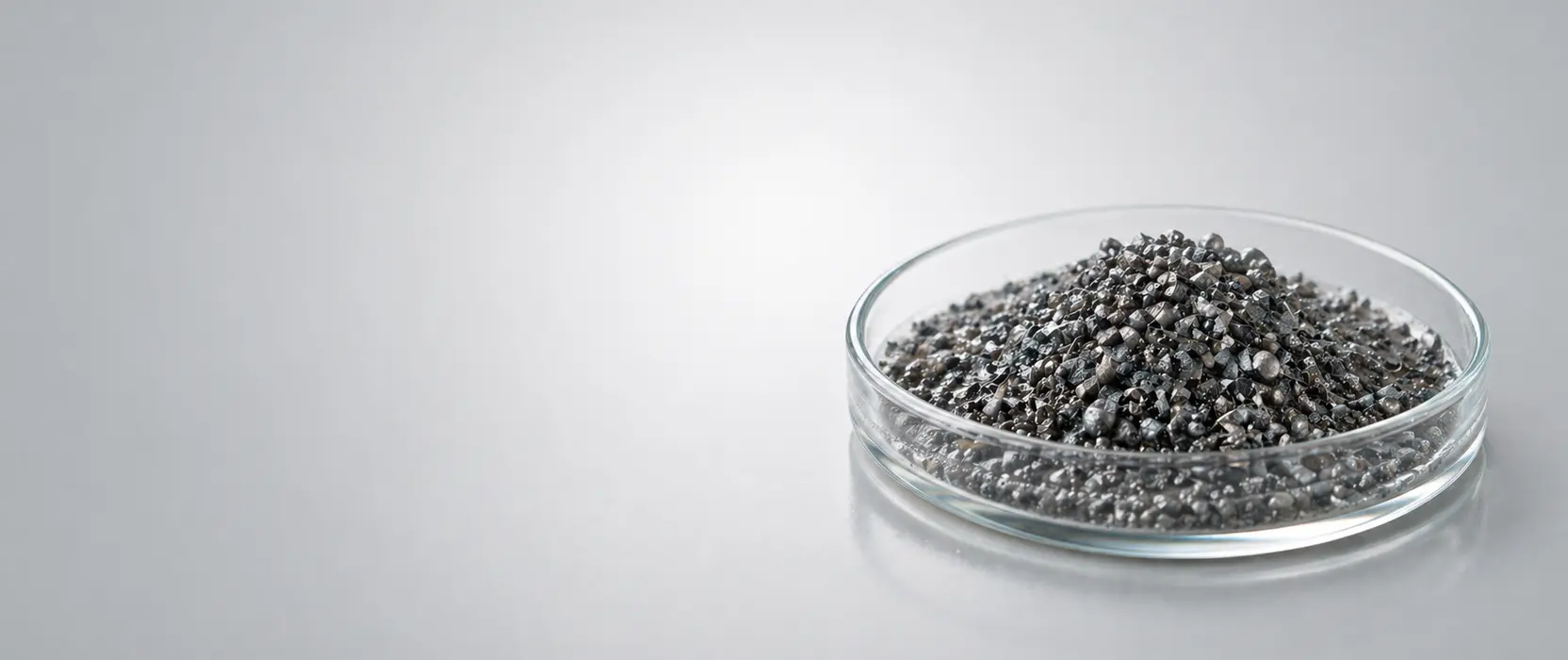
When firing, a cartridge’s propellant does not burn completely. A portion of the propellant powder—either nitrocellulose powder or black powder, depending on the type of ammunition and firearm—ends up as residue on the range. This residue settles on the range floor, particularly in the first five to ten meters in front of the shooter’s position, where experience shows the largest amounts accumulate.
These deposits must be removed regularly. This is not a matter of cleanliness, but a safety requirement: propellant residue is flammable and, under certain conditions, highly combustible.
Why a vacuum cleaner is not just any old choice here
The typical assumption is that a powerful industrial vacuum with a suitable filter is sufficient for this task. That is not true.
Propellant powder is highly sensitive to mechanical and electrostatic ignition sources. Sparks—caused by electrical components or electrostatic discharge in the vacuum system—can lead to spontaneous combustion or deflagration of the vacuumed material. The risk does not arise when the powder is lying on the floor, but during vacuuming: In the suction stream, the powder is concentrated, accelerated, and passed through narrow cross-sections—conditions under which uncontrolled ignition sources are particularly dangerous.
What "ignition-source-free design" means in practice
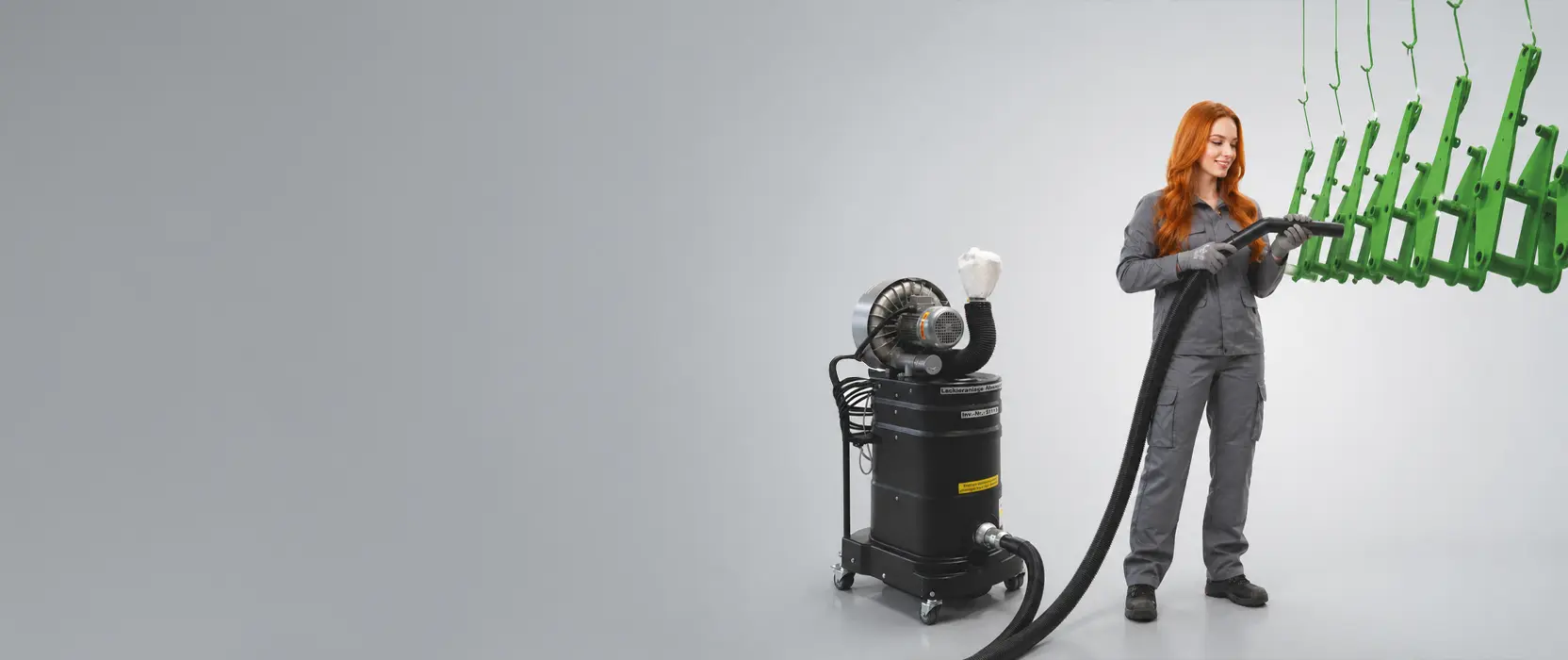
For the safe extraction of propellant powder residues, equipment approved according to ACD or ATEX zone 22 is required. Both standards define requirements for equipment used in areas with combustible dusts—with the goal of structurally eliminating all potential ignition sources.
In practice, this involves several coordinated measures. The housing is made of electrically conductive, glass-fiber-reinforced thermoset plastic—a material that dissipates electrostatic charge before it can discharge. All dust-carrying components have smooth interior surfaces to prevent deposits that could become dislodged by vibration and ignite. The air velocity in the suction hose is designed to prevent critical pressure spikes.
The filter system is two-stage: a dust class M filter retains the majority of particles, while a downstream residual dust filter of dust class H ensures that even the finest particles do not reach the exhaust air. The cleaned exhaust air can be safely returned to the room.
Mobility as a Design Requirement
Indoor shooting ranges present a specific spatial challenge: the shooting lane is long, and the relevant deposits are spread over several meters. A suitable extraction system must therefore be flexible enough to be used along the entire length of the lane—without cables that restrict the range of motion, safety, or workflows.
Battery-powered variants meet this requirement by design. They enable uninterrupted cleaning along the entire shooting range and reduce tripping hazards caused by cable connections. The tool-free battery change ensures that cleaning intervals can be integrated into ongoing operations without additional downtime.
What this requirement demonstrates
In such applications, it becomes clear that the suitability of an extraction unit is not determined by its suction power, but by its safety certification and the design-based implementation of ignition-source-free operation. What matters is not the device’s maximum performance, but the systematic avoidance of potential ignition sources throughout the entire extraction process. Both must be considered as a system—the housing, airflow, filter design, and drive all work together.
The normative basis—ACD or ATEX zone 22—is not a restriction but a guideline: It defines what a device must do so that the operator fulfills their duty of care.
Classification
In indoor shooting ranges, cleaning is not a secondary process but part of the safety concept. The choice of extraction system is therefore not a minor decision but a matter of operational safety.
RUWAC develops industrial vacuum cleaners specifically for these requirements—in ACD and ATEX zone 22 design variants, with a conductive GRP housing, a two-stage filter system, and battery or three-phase drive. What matters is not just the device’s performance, but its design for safe continuous operation in safety-critical facilities.